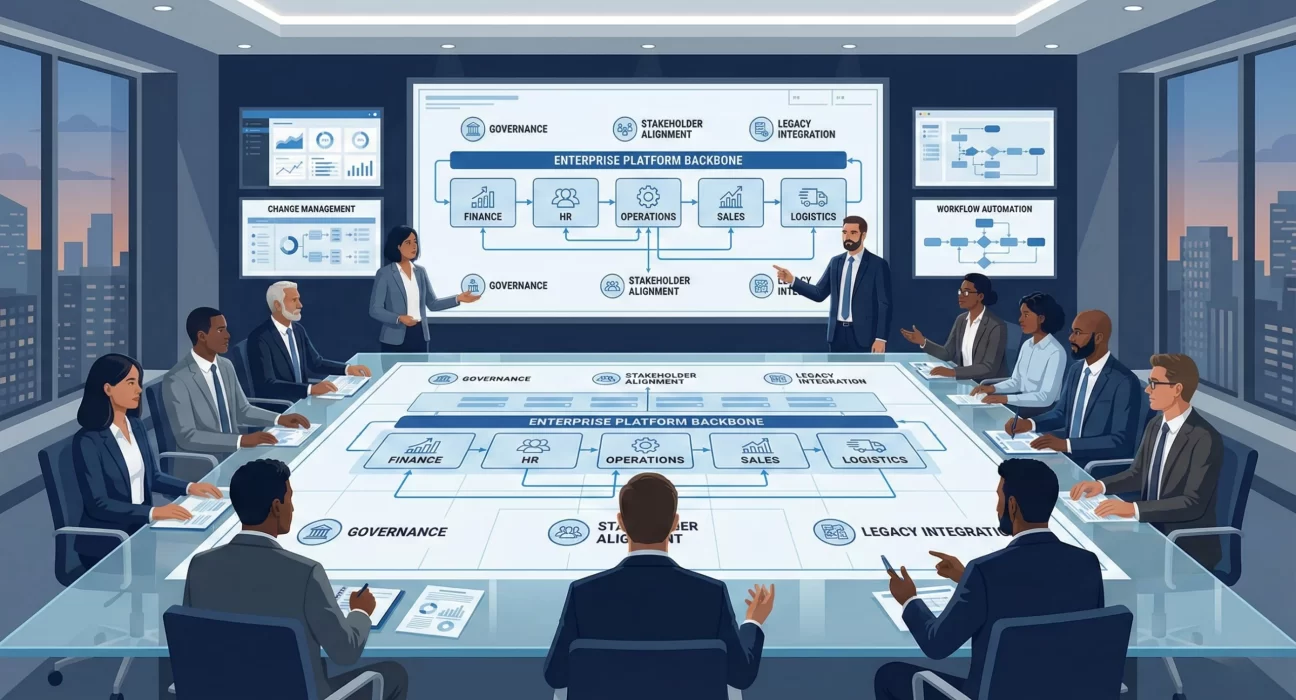
Every large enterprise eventually reaches a point where their systems can no longer keep up with their business. The sales team needs better visibility into inventory. Finance wants real-time reporting. Operations is tired of reconciling data across five different tools. Customer service is drowning in tickets because information lives in silos.
The natural response is to build or buy a platform that can serve multiple business functions. Something horizontal that cuts across verticals. A single source of truth. An integrated backbone. A modern foundation for the next decade of growth.
It sounds straightforward on paper. In reality, it’s one of the hardest things an enterprise can attempt.
Most large-scale platform programs either fail outright or limp along for years, burning cash and goodwill until someone finally pulls the plug. The ones that succeed don’t do so because they picked the right technology. They succeeded because they understood what kind of problem they were actually solving.
Why Horizontal Platforms Are So Hard to Get Right
Building a horizontal platform for a vertical enterprise means you’re trying to create something that works for procurement, HR, sales, operations, finance, and logistics all at once. Each of these functions has its own language, its own processes, its own legacy systems, and its own idea of what “good” looks like.
The complexity isn’t technical. It’s organisational.
When you have a thousand employees spread across ten cities, each with their own way of doing things, you’re not just building software. You’re negotiating turf. You’re challenging entrenched workflows. You’re asking people to change how they work, and you’re doing it at scale.
This is where most programs start to unravel.
The technical team builds what was specified. But the specifications were written by someone in the head office who didn’t fully understand how the Pune warehouse operates differently from the Bengaluru warehouse. Or how the finance team in Chennai has a completely different month-end close process than the one in Gurugram. Or how sales in the North has been using a workaround in Excel for three years that nobody documented.
By the time these gaps surface, you’re six months into development, budgets are spent, and the steering committee is asking why the go-live got pushed again.
The Real Challenges Nobody Talks About Enough
Stakeholder Alignment That Actually Holds
In theory, everyone wants a unified platform. In practice, every department head wants it built their way.
The CFO wants tight controls and audit trails. The COO wants speed and flexibility. The CIO wants something that won’t become a maintenance nightmare in two years. The business unit heads want features that solve their problems today, not six months from now.
Getting alignment in the first steering committee meeting is easy. Keeping that alignment through eighteen months of delivery, three scope changes, two leadership transitions, and one budget reforecast is a different matter entirely.
Most enterprises underestimate how much continuous stakeholder management a platform program requires. It’s not a one-time requirements gathering exercise. It’s an ongoing negotiation between competing priorities, limited budgets, and real business pressure.
Governance That Doesn’t Strangle Delivery
Enterprise governance exists for good reasons. You need controls, approvals, risk reviews, security checks, and compliance gates. But governance structures designed for running steady-state operations often kill platform programs.
When every decision requires three committees and two weeks of approvals, delivery slows to a crawl. When the program team can’t make a call on something without escalating to the steering committee, you lose agility. When risk frameworks designed for traditional waterfall projects get applied to iterative platform builds, you end up with theatre instead of progress.
The best programs find a way to balance control with speed. They create fast-track approval paths for low-risk decisions. They empower the program leader to make calls within defined guardrails. They treat governance as an enabler, not a gatekeeper.
The Legacy System Problem
No large enterprise is starting from a clean slate. You have systems that have been running for fifteen years. Databases with millions of records. Integrations nobody fully understands anymore. Processes that have workarounds built on workarounds.
Your new horizontal platform has to work alongside all of this. It has to integrate with SAP, or Oracle, or that custom-built system from 2009 that only two people in the company know how to maintain. It has to migrate data that’s messy, incomplete, and often contradictory across sources.
This is not a technical problem you can solve by picking the right API framework. It’s a sequencing problem, a change management problem, and a business continuity problem all rolled into one.
Enterprises that succeed at this don’t try to do everything at once. They phase the rollout. They run parallel systems for longer than they’d like. They invest in data cleanup before migration, not after. They accept that transformation is measured in years, not quarters.
Vendor and Partner Management
Most enterprises don’t build platforms entirely in-house. They work with system integrators, technology vendors, niche specialists, and consulting firms. Managing this ecosystem is a program in itself.
The platform vendor tells you their product can do everything you need. The system integrator promises to deliver on time and on budget. The consulting firm brings in a team of people who bill by the hour and rotate out every few months.
Without strong internal ownership, you end up with a program that’s vendor-driven instead of business-driven. Decisions get made based on what’s easy for the vendor, not what’s right for the enterprise. Costs spiral because nobody’s really watching the burn rate week to week. Quality suffers because the vendor’s definition of “done” isn’t the same as yours.
Successful enterprises treat vendors as partners but never abdicate responsibility. They keep ownership internal. They build a core team that understands both the business and the technology deeply enough to hold vendors accountable.
What Separates Success from Failure
Clear Ownership and Accountability
The single biggest predictor of success in a large platform program is whether someone senior owns it end-to-end.
Not a steering committee. Not a vendor. Not a PMO that’s managing fifteen other programs at the same time. One person, with real authority, who wakes up every day thinking about this program and nothing else.
This person needs to be senior enough to make decisions and resolve conflicts without endless escalations. They need to understand the business well enough to know when to push back on requests that don’t make sense. They need to be technical enough to have credible conversations with the engineering team. And they need to have the trust of leadership to navigate the inevitable challenges without getting sidelined.
When this role is filled by someone who’s just managing a process rather than driving an outcome, programs drift.
Execution Maturity, Not Just Technical Maturity
Technology choices matter, but they’re not the hard part. Every major platform technology can work if implemented well. Most failures happen because of poor execution, not poor technology.
Execution maturity means you have a program team that knows how to sequence work, manage dependencies, track progress honestly, identify risks early, and course-correct without drama. It means you have delivery processes that are rigorous without being bureaucratic. It means you have a culture that values shipping working software over producing perfect documentation.
Enterprises with strong execution maturity deliver platforms that work. Enterprises without it deliver platforms that sort of work, kind of, most of the time, if you don’t push them too hard.
Realistic Timelines and Budgets
Every platform program starts with aggressive timelines because that’s what the business wants to hear. Go live in twelve months. Budget of X crores. Full rollout across all locations by next fiscal year.
Three months in, reality sets in. The requirements were more complex than anticipated. Integration with legacy systems is taking longer. The vendor needs more time for customisation. Key resources got pulled into a business-critical issue.
Enterprises that succeed build buffers into their plans from the start. They commit to phases, not the whole transformation at once. They’re honest with stakeholders about what’s achievable and what’s not. They resist the pressure to overpromise just to get approval.
Programs that fail are often doomed from day one because the commitments made were never realistic to begin with.
The Right Partnership Model
Building a horizontal platform for a vertical enterprise requires a partner who understands enterprise realities, not just software development.
You need a partner who’s been through multi-year programs before. Who knows how to work within governance structures without letting them become blockers. Who understands that delivery isn’t just about writing code, it’s about change management, stakeholder alignment, training, data migration, and everything else that makes a platform actually work in production.
This is where firms like Ozrit come in. The difference between a typical vendor and a true delivery partner is that the latter doesn’t just build what you spec out. They challenge assumptions. They bring experience from other complex programs. They help you navigate the organisational and operational challenges that sink most platform initiatives.
A strong partner integrates into your team rather than staying at arm’s length. They care about the outcome, not just the contract. They stay through go-live and stabilisation, not just handover. They help you build internal capability so you’re not dependent on them forever.
What Leadership Should Focus On
Treating Platforms as Business Programs, Not IT Projects
The moment a platform program gets labelled as an IT initiative, it’s at risk. IT doesn’t control the business processes that need to change. IT doesn’t own the data quality issues that need fixing. IT can’t mandate adoption across business units.
Platform programs need to be owned by the business, with IT as a critical partner. The program sponsor should be a business leader who has skin in the game. The success metrics should be business outcomes, not technical milestones.
When leadership treats the platform as strategic, it gets the attention, resources, and decision-making speed it needs. When it’s delegated to IT and left to drift, it becomes another failed transformation story.
Investing in Change Management Early
Technology is only half the battle. Maybe less than half.
If people don’t adopt the new platform, it doesn’t matter how well it was built. And adoption doesn’t happen by accident. It requires training, communication, support, incentives, and sometimes tough conversations with people who resist change.
Most enterprises underinvest in change management until it’s too late. They assume that if you build it, people will use it. Then they’re surprised when the new system sits unused while everyone goes back to their old Excel sheets and email workflows.
Change management isn’t a workstream you add at the end. It’s something you start planning from day one. You identify champions in each business unit. You communicate the “why” before the “how”. You make it easy for people to learn and get support. You track adoption metrics as seriously as you track delivery milestones.
Being Willing to Make Hard Calls
Platform programs surface uncomfortable truths. Processes that don’t make sense. Teams that are understaffed. Data that’s been wrong for years. Vendors that aren’t delivering.
Leadership has to be willing to act on these truths. If a process needs to change, change it. If a vendor isn’t performing, replace them. If the timeline isn’t realistic, reset expectations.
The worst thing leadership can do is ignore problems and hope they resolve themselves. They don’t. They compound. And by the time they become impossible to ignore, you’ve lost months and credibility.
Getting Platforms Right
There’s no magic formula for building horizontal platforms for vertical enterprises. Every organisation is different. Every context has its own constraints.
But there are principles that hold true.
Keep ownership clear and accountability high. Build with the business, not just for the business. Manage stakeholders continuously, not just at the start. Respect governance but don’t let it paralyse delivery. Invest in change management as much as technology. Work with partners who’ve done this before and know what it really takes.
Most importantly, be realistic. Platforms are long-term plays. They don’t deliver value overnight. They require patience, persistence, and a willingness to work through complexity without shortcuts.
The enterprises that succeed at this are the ones that treat platform programs as strategic, multi-year transformations requiring senior leadership attention, strong execution capability, and a culture that values delivery over promises.
It’s hard work. But when done right, a well-built horizontal platform becomes the foundation for everything that comes next. It enables growth. It improves decision-making. It frees your people from fighting systems and lets them focus on the work that matters.
That’s the outcome worth working toward. Everything else is just noise.